The boardroom in 2030
Two of the most important builders in AI, Elon Musk and Sam Altman, say intelligence is about to become abundant. Follow their logic, and it raises a larger question: what does that mean for how your board governs, and leads, between now and 2030?
Sam Altman does not think the singularity is coming. He thinks it is already here. On the Relentless podcast, he said: "We are now, like, in the singularity. This is the moment." Present tense, not a forecast.
Elon Musk is putting numbers on the same idea. In his July 2026 interview with The Economist, he said AI "will exceed the intelligence of any individual human probably within about two years, and exceed the intelligence of all humans combined in about five years." He went further in the same conversation, and said money itself may become largely irrelevant within a decade. His reasoning is that we will see an abundance of goods and services as AI makes it much cheaper to produce anything, and that this increase in supply will dramatically lower prices.
What do you want money for? You want money for goods and services. Food, housing, transport, entertainment. Well, if robots and AI are providing more goods and services than any human could possibly consume, what do you need money for? Inflation is simply the ratio of money to goods and services. If the goods and services output increases dramatically, these things were relevant in the past. They will not be relevant in the future.
Even if Elon is not entirely right about his 2036 predictions, strip out the science fiction and one claim survives that a board cannot wave away. Intelligence is on its way to becoming abundant and cheap.
That single fact should make us pause and ask what it means for the boardroom today.
When intelligence is abundant, it stops being the scarce thing. Anyone can produce an analysis, a memo, a model, a confident answer, in seconds. What becomes scarce is the ability to tell a good answer from a convincing wrong one, and to decide under pressure when the stakes are real. Judgment will matter more than ever.
So the real question for 2030 is not whether your company has AI. Everyone will have AI. The question is whether your board has more foresight than the board across the street.
The advantage in 2030 is not having AI. It is governing AI well, and most boards are not yet set up to do it.
Does leadership matter less, or more?
The obvious fear is that abundant intelligence makes human leaders redundant. Why keep a board, or a chief executive, when the machine is smarter than all of them combined? Musk, who is as bullish on the technology as anyone alive, points the other way. Asked what the real challenge becomes, his answer was not about capability. It was about control. The biggest challenge, he said, "will be aligning AI with humanity's interests."
Sit with that, because it is a governance statement, not a technical one. Alignment is the problem of making a powerful system serve the interests it is meant to serve. Scale it down from humanity to a single company, and it is the work a board already does. Aligning management with shareholders. Aligning incentives with the long-term health of the business. Aligning what the company can do with what it should do. Give a company a tool more capable than any person in it, and the alignment problem does not shrink. It becomes the main focus.
That is why leadership matters more in this world, not less. When intelligence was scarce and expensive, much of leading was gathering it: hiring the analysts, commissioning the study, reading the deck. When intelligence is cheap and everywhere, that part collapses, and the harder part is left standing. Deciding what the company is for. Choosing which risks are worth taking. Saying no to a confident answer that happens to be wrong. A smarter model does none of that. All of it stays with the people in the room.
Stop treating AI as an IT project
For most boards, AI still sits in the wrong place on the agenda. It is treated as a technology matter. It goes to the audit committee as a risk, or to a technology sub-committee, or to whichever director is assumed to be good with this sort of thing. It gets forty minutes once a quarter, after the numbers.
That placement made sense when AI was a tool the company used. It makes no sense when AI is the thing reshaping the company's cost base, its competitors, its workforce and, if Musk is even partly right, the market it sells into. A change of that size is not a committee item. It is a full-board matter, tied to strategy, capital allocation and talent.
The gap is well documented. A 2025 Deloitte study of directors found that two in three describe their board as having limited to no experience with the technology, and two in five say it has already caused them to reconsider the makeup of their board. Naming the gap is not the same as closing it. Most boards have named the problem and changed very little about how they actually run.
Consider what the reframe changes in practice. A board that files AI under technology asks whether the company's tools are secure and whether the spend is under control. A board that treats it as strategy asks whether the company still has a business in five years, and what it is doing now to make sure of it. The first board is satisfied by a compliant vendor list. The second is not satisfied until it understands how the company will make money when its competitors can buy the same capability it once had to build.
Governing AI as a transformation means asking larger questions than the technology committee asks. Not only whether the deployment is secure and compliant, though that matters. Which parts of our business model assume human labour that is about to become optional? Where does our position depend on a cost or a capability a competitor can now buy off the shelf? What happens to our pricing if our main input, expertise, drops in cost by an order of magnitude? Those are strategy questions. They belong to the whole board.
Govern for abundance and displacement at once
The hard part is that the upside and the downside arrive together, on the same wave.
On one side is abundance. Work that took a team now takes an afternoon. Products that needed a large organisation can be built by a small one. Markets that were closed on cost open up. On the other side is displacement. Roles disappear. Business models that looked durable stop working. Advantages built on scale, or on holding better information than the other side, erode when the same capability is available to anyone with a subscription.
A board cannot govern for only one of these. Chase the abundance and ignore the displacement, and the write-down, the restructuring and the regulator arrive without warning. Fear the displacement and ignore the abundance, and a smaller competitor takes the market while you deliberate. The task is to hold both at once. That is harder than either alone, and it is exactly the kind of judgment a board exists to bring.
The software industry is already living this. Roles that were scarce and expensive two years ago are being automated, while small teams ship products that would once have taken hundreds of people. Both facts are true at the same time, in the same industry. Any board in or near that industry has to plan for both, and cannot treat one as the story and the other as a footnote.
This is where scenario work earns its place on the agenda. Not the tidy three-scenario deck that ages in a drawer. A live question, put at every meeting: if the cost of intelligence keeps falling at the current rate, what breaks in our plan, and what opens up? A board that has genuinely worked that question is much harder to surprise.
The board is becoming the slowest instrument in the company
Governing at this speed exposes a mechanical flaw in how boards work.
Today, management writes one deck. Sometimes it runs to 80 pages, sometimes to 800. It often lands the night before the board meeting. Every director reads it through the same management summary, under the same time pressure, in the same few hours carved out of another full job. Everyone works from one version of the truth, and it belongs to the very people the board is meant to hold accountable.
That model was tolerable when decisions matured over a quarter. It is not tolerable when they have to be made in days. A trade rule shifts over a weekend. A competitor ships something that resets the market. A breach is found on a Friday, and the disclosure decision cannot wait for Monday's open. In each case the facts that matter sit somewhere in the company's own records, and there is no time to read the way a board once could.
For a generation, the binding constraint on a board has been reading time. Even the best directors miss the covenant in the footnote, because there are 800 pages and one evening. The constraint has to move: from what a director had time to read, to the quality of the director's judgment. That is the right place for a board to be limited, and for most of the history of boards it has not been possible.
One director, one analyst
One change that moves the constraint is already arriving. By 2030, each director will walk in with an analyst of their own. Not a shared tool for the whole board, but a dedicated one per seat, working the board's own materials inside a sanctioned space the company controls.
The audit chair's analyst goes for the disclosures, the covenants and the related-party lines, and names the item that should be in the deck and is missing. The compensation chair's analyst models what the incentive plan actually rewards, against what the summary claims it rewards. The lead independent director's analyst tests the management story against the company's own filings and outside benchmarks. The same people sit around the table, with a separate, independent reading of the full picture for every seat.
How each seat reads the board deck
| The seat | The duty it carries | What that director's analyst reads for |
|---|---|---|
| Audit committee chair | Financial integrity and disclosure | Disclosures, covenants, guarantees, related-party lines, and the item that should be in the deck and is missing |
| Compensation committee chair | Pay aligned with performance | What the incentive plan actually rewards, against what the summary says it rewards |
| Lead independent director | Independent challenge to management | The management narrative tested against the company's own filings and outside benchmarks |
| Investor-director | The thesis and the fund's capital | The original investment case, applied to every portfolio company's deck at the same standard |
Consider a familiar case. A quarterly deck arrives with a summary describing comfortable liquidity. Deep in an appendix sits a schedule showing a covenant that tightens next quarter and a customer concentration that has quietly grown. Whether any director catches it today depends on who had the stamina to reach the appendix at midnight. With a reading tuned to the audit seat, both surface on the first page a director sees, each with its source page attached. The director still decides what it means. The difference is that the director gets to decide, rather than never seeing it at all.
This is already happening, without the guardrails. A June 2026 survey of public company directors by Corporate Board Member and the Diligent Institute found that 82 percent had used generative AI in their board work in the previous six months, up from 66 percent only nine months earlier. Yet 54 percent said their company gives them no guidance on how to use it safely, and only 6 percent had a policy written for the board. Nearly half had heard of fellow directors running board material through consumer AI tools. Directors are not waiting for permission. Most are already using these tools, and most have no safe place to do it.
That is the risk, and it is the whole point. This only works if it is sanctioned. A director quietly pasting a confidential board deck into a personal chatbot breaks the confidentiality the seat is bound to protect, and the first serious leak will get AI banned from the boardroom for everyone. The deck has to stay under the company's control, and it must never be used to train a model. A free-for-all of personal accounts is not the future of the boardroom. It is the fastest way to lose it.
This is the gap BoardLens was built to close, and to set a standard for what governance-grade AI in the boardroom should mean: a sanctioned workspace where the board's own materials stay under the company's control, are never used to train a model, and every answer traces back to the page it came from. The answer is not to slow AI down. It is to build the guardrails that let boards move faster, with confidence.
The standard of care is rising
There is a legal edge to this that directors should see coming. Under the Caremark line of cases, and more clearly since the Delaware Supreme Court decided Marchand v. Barnhill in 2019, directors carry a duty of oversight that good intentions do not satisfy. The board must make a genuine, documented effort to inform itself about the matters critical to the company. The duty is not to be told. It is to have tried to know.
Set that duty beside tools that let any director read the entire record, and the direction is clear. A capability that plainly exists becomes one a court, a regulator or a plaintiff's lawyer can later ask why a director did not use. The reasonable-director standard is not fixed. It tracks what a reasonable director could reasonably do, and the range of what a director can do is about to widen a great deal. Directors' and officers' insurance may soften the financial blow of a claim. It does not cover a director's name, or the years a serious failure takes out of a life. That exposure has always been personal, and the new tools make it sharper, not softer.
Seeing across the whole portfolio
The larger prize is not the single reading. It is being able to see across everything at once.
Few experienced directors hold one seat. They hold several, often alongside their own investments. Each board sends its own deck on its own schedule, and no one reads two thousand pages a quarter with equal care across eight companies. The pattern that only shows up across the set goes unseen: the same customer concentration in two holdings, the same covenant tightening across an industry, the same optimistic assumption baked into three different management cases. The cost of missing it is rarely dramatic in the moment. It shows up a year later, as the markdown or the restatement that a wider view would have caught while it was still small.
For a fund the point sharpens. When every partner has an analyst, the advantage is no longer who reads fastest. It is which firm can see across its whole portfolio at once. That is a firm-level capability, not something individual partners assemble on their own. The people who allocate capital have started to ask for it, too. Increasingly, limited partners want more than returns. They want evidence of how a firm monitors its holdings, and how fast it would catch a problem in one of them.
By 2030, the question your investors and your shareholders ask will not be whether you use AI. It will be what you can see across the whole business, and how quickly.
A five-year board agenda
None of this requires waiting for 2030. A board that wants to be ready has a short, concrete agenda, and every item on it belongs to the board rather than to management.
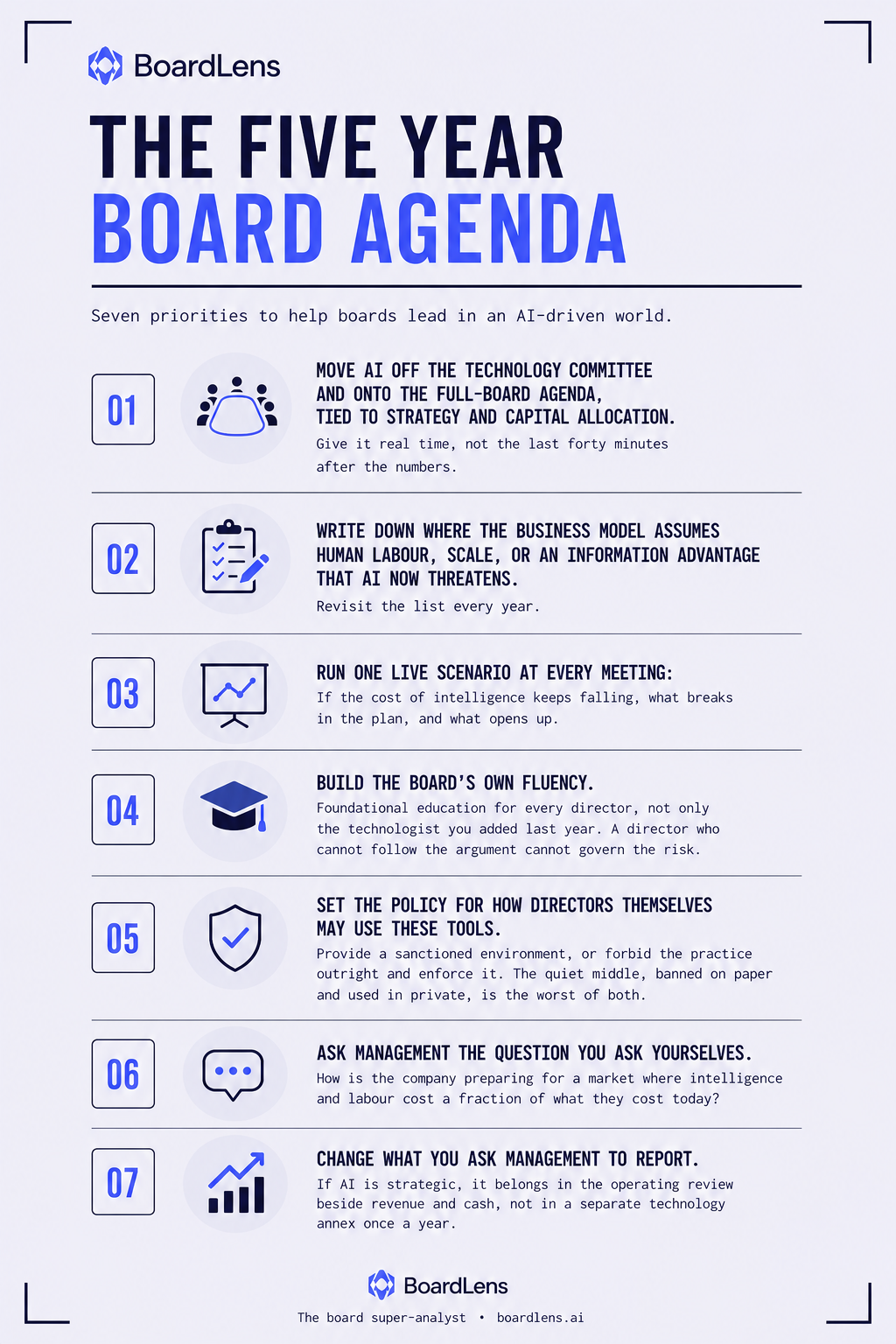
- Move AI off the technology committee and onto the full-board agenda, tied to strategy and capital allocation. Give it real time, not the last forty minutes after the numbers.
- Write down where the business model assumes human labour, scale, or an information advantage that AI now threatens. Revisit the list every year.
- Run one live scenario at every meeting: if the cost of intelligence keeps falling, what breaks in the plan, and what opens up.
- Build the board's own fluency. Foundational education for every director, not only the technologist you added last year. A director who cannot follow the argument cannot govern the risk.
- Set the policy for how directors themselves may use these tools. Provide a sanctioned environment, or forbid the practice outright and enforce it. The quiet middle, banned on paper and used in private, is the worst of both.
- Ask management the question you ask yourselves. How is the company preparing for a market where intelligence and labour cost a fraction of what they cost today?
- Change what you ask management to report. If AI is strategic, it belongs in the operating review beside revenue and cash, not in a separate technology annex once a year.
What will not change
For all of it, the part that matters most does not move.
The analyst never casts the vote. It never sits in the meeting. It never carries the liability, and it never will. After years on boards, I am more convinced than ever that judgment is the part you cannot automate: the read on a management team, the memory of the last downturn, the instinct that a number is technically correct and still misleading. A model can surface the transaction. Whether it is a problem or a routine, fairly priced arrangement is a judgment, and judgment is the job.
So the honest claim is a modest one. AI does not replace the board. It raises the standard the board is held to, and it removes the excuse that the information was out of reach. A director who decides without understanding the business has one fewer place to hide. A director who understands it has more room to do the real work of the seat.
The bottom line is not complicated. The people building AI are telling you, in plain language, that intelligence is about to become abundant. They may be early on the timing. They are unlikely to be wrong on the direction. When intelligence is abundant, judgment is what becomes scarce, and governing AI well is what will separate one board from the next. The advantage in 2030 will not be having AI. Everyone will have it. The advantage will be governing it better than anyone else.
A board that files this under information technology is making a large strategic bet without admitting to itself that it is making one. The wiser course is not to predict the date. It is to build a board that can govern whichever version of this future arrives, and to start now.
Two questions are worth carrying into your next meeting. For today: in a world with more information and less time, how does your board actually cut through the noise and decide? For the near future: by 2030, what will your shareholders, and your limited partners, expect you to see across the business, and how fast will they expect you to see it?
If you want to get ahead of the future described here, that is exactly what our new course is built for. Frontier AI for Leaders and Boards is a short executive course on where AI is heading and how boards and investors can get ready to govern it. Take the course.
Raffaela Rein has served on boards ranging from publicly listed companies valued in the tens of billions to early stage startups. She is the CEO of BoardLens, a sanctioned AI workspace for boards and investors, and writes The AI Leadership Edge newsletter with 14,000 subscribers.
Five questions to settle before any director uses these tools. Boards that want a policy on this can start with five questions. Each has a right answer, and none of the right answers is hard to reach.
- Where do the materials live? In a company-controlled environment, or on a personal account. Only the first is acceptable.
- Is the vendor barred from training on the data? The contract should say so in writing, and should also bar the vendor from keeping the materials beyond the work itself.
- Who can see what? Access should be logged, seat by seat, so the board knows who read what, and when.
- Does the tool cite its sources? Any figure or flag it produces should point to a page in the deck, so a director can verify it rather than trust it.
- Who owns the output? The analysis belongs to the company and the board, not to the vendor, and it should be covered by the same confidentiality that protects the deck itself.
A board that can answer these five has a policy. A board that cannot has an exposure, whether or not it has noticed. The questions cost an afternoon. The alternative can cost a name.
Enjoyed this? Get the next one.
Subscribe to The AI Leadership Edge for new insights as they land.