The analyst your fund
doesn't have to hire.
A senior analyst on every board, without the headcount. One living intelligence layer that reads every board deck, investor update and LP report across your whole portfolio, plus thousands of outside signals, all through your firm's lens: your thesis and your team's expertise. Give a lean team the reach of a much bigger one, more coverage, less slipping through the cracks, and stewardship you can prove to LPs.
Live with 10+ funds · €100M–€3B AUM · SOC 2 audit-ready, monitored daily · Your data, never trained on
“Board work is becoming increasingly complex. BoardLens finally enables boards to leverage the power of AI in a secure, compliant, and purpose-built environment.”
 Prof. Dr. Feiyu XuSupervisory board member at Siemens Energy, Airbus Group (ex), FAZ and ZF Group. Former Global Head of AI at SAP. University Professor of Industrial AI.







Four partners. Twenty boards.
No analyst who can keep up.
Your partners sit on 10, 20, 30 boards between them. Each deck runs 200 pages and lands 48 hours before the meeting, thousands of pages a quarter, on top of sourcing, diligence and the rest of the job. The number that matters is on page 137. Today the only way to catch it is to read everything, or hope someone did. Across a portfolio, neither scales.
Volume no team can read
Portfolio-scale pages against a thin team and no dedicated analyst, the reality for nearly every emerging manager and family office. The work the role requires doesn't fit the hours anyone has.
Things slip, and no tool holds the whole picture
A commitment dropped here, a runway gap there, a narrative reframed between updates. Across 20 companies no single person holds the whole picture, and a general AI forgets last quarter, with no memory across cycles and no portfolio view. Across a portfolio, important changes are simply too easy to miss.
The analyst you can't staff, or share
The work needs a senior analyst per company. But it's too sensitive for a junior, too expensive to staff across the portfolio, and too important to skip. So partners do it themselves, at night.
Confidential materials in open AI
As teams adopt general AI tools, confidential board materials can easily move outside the fund's sanctioned environment. BoardLens gives partners a purpose-built way to use AI while keeping sensitive portfolio information under the fund's controls.
Management said 7 months of runway. The real number was 3.
Our founder was an investor-director when management presented a 7-month runway. Run the math against the burn rate buried in a cash-flow appendix, and it was closer to 3. No one on the board caught it. The company went bankrupt.
Had BoardLens existed, it would have flagged the gap on Sunday night. The partners walk in Monday and shift the conversation from quarterly review to bridge round, the one move that saves a company three months from zero. Across a portfolio, surfacing that kind of discrepancy early can materially change the options available to the board and investor.
Financial Position & Runway
Your whole portfolio, amplified.
Two layers, one source of truth, across every company the firm holds. Each becomes a living profile, your decks, investor updates and LP reports fused with thousands of external data points, refreshed every cycle, and then every analysis your partners run reasons through your firm's lens: your thesis and your team's expertise.
A continuously-enriched 360° profile of every company you hold.
Portfolio analyses every partner runs, through your firm's lens.
“Both our executives and board members use BoardLens together. It's become our shared platform for stronger strategic conversations and better-prepared board meetings.”
 Wolf-Ingomar FaecksChairman of the Supervisory Board, Tallence AG
Better-prepared directors. Stronger board-management dialogue. More productive meetings.
Learn more about Governance Grade AI →See it in action
Every partner sharper on every board, and the whole portfolio in view, without the headcount.
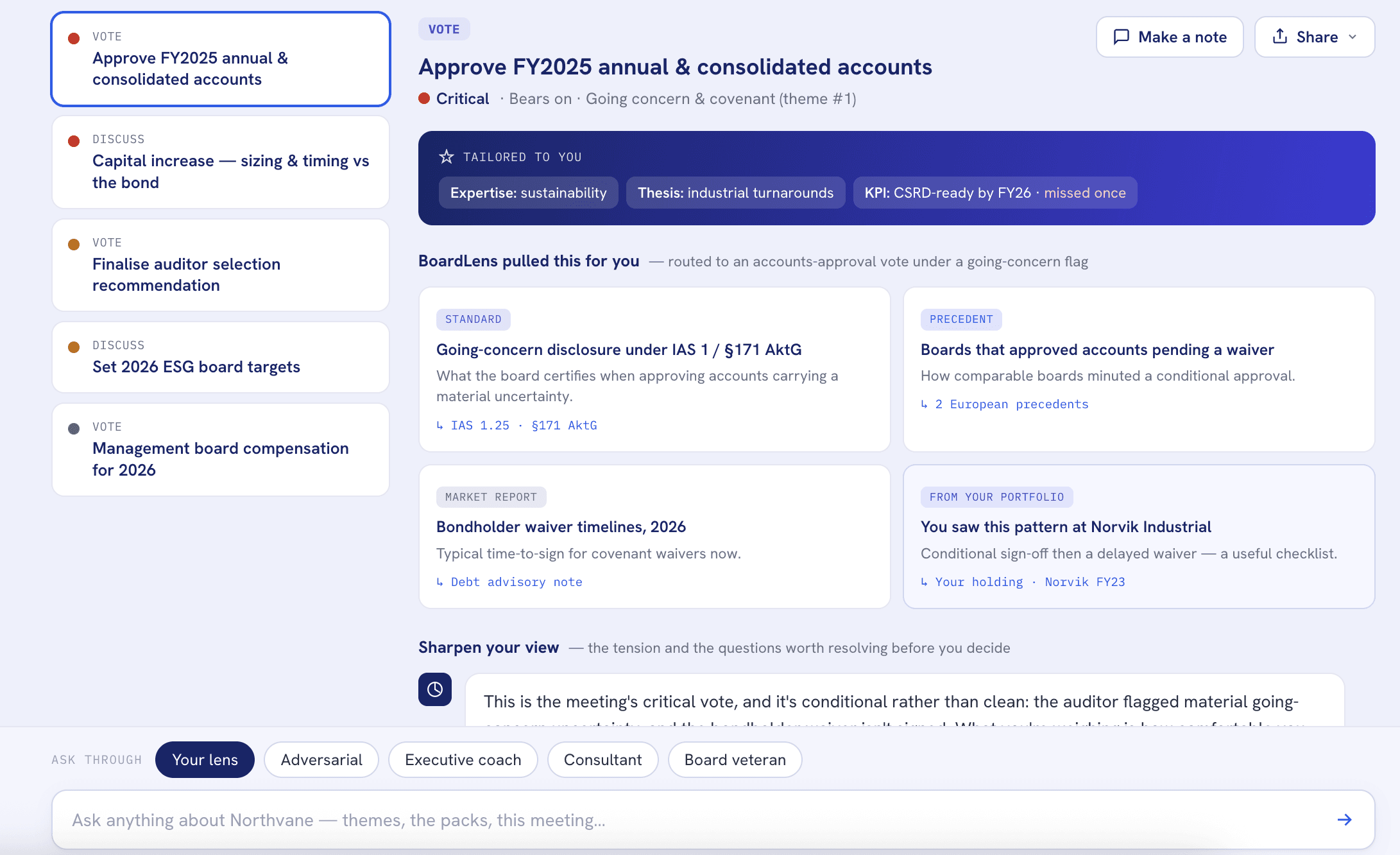
Every theme and vote, analysed in your firm's lens, enriched with thousands of data points.
Each decision comes back through your firm's lens, your thesis and your team's expertise, enriched with thousands of outside data points, and ready to pressure-test your own thinking through four challengers: skeptic, executive coach, consultant and board veteran. Every partner walks in sharper, in a fraction of the time.
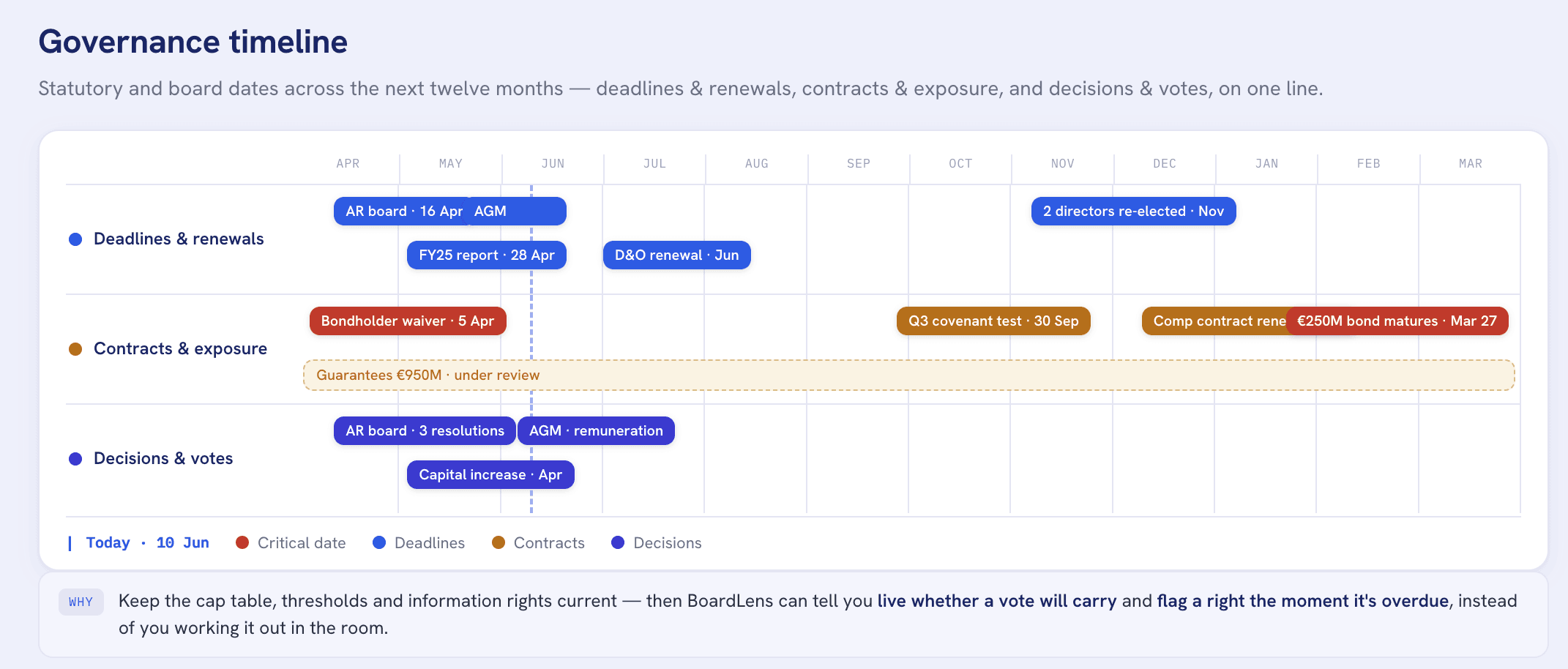
See what's drifting across all your companies before it's a fire drill.
The senior analyst you don't have to staff, applied across the portfolio. Commitments, runway changes and financing milestones surfaced across every company at once, with LP-ready synthesis without the manual rebuild.
AUM already in beta with BoardLens, VC, growth and private-market investors, and the directors who steward their companies.
Directors must acquire new knowledge rapidly.
Boards face unprecedented complexity, AI, ESG, cyber, regulation, yet directors work with outdated tools, drowning in information but starved for insight.
Could I have done more to see it coming?
I sat on the board of a bank that later hit crisis. Could I have anticipated the risks and steered differently? It's a question that still stays with me.
Investors maximise impact through board work.
I serve on 20 boards with three full-timers supporting that work. BoardLens could free that time, and make me better prepared at every meeting.
From buried in decks to ahead of every board.
BoardLens changes what your partners bring to every board and how clearly the firm sees its own portfolio. You walk in sharper, surface what matters earlier, and see all 20 companies at once instead of one deck at a time.
Be the best-prepared voice on every board.
The three questions that matter, every commitment and whether they hit it, the number that doesn't reconcile with last quarter. Founders and co-investors notice within one cycle. Your partners arrive ready to contribute on the strategic questions that matter.
See the whole portfolio, without the headcount.
What's drifting across all 20 companies before it becomes a fire drill, the runway gaps, the reframed strategy, the overdue raise, surfaced across the portfolio at once. The senior analyst you don't have to staff: cover 15 portcos in the time it took to cover 5, without expanding payroll.
LP reporting without the manual grind.
The quarterly synthesis your team rebuilds by hand every cycle, the strategic narrative inside each company, generated against accumulated history and shaped for internal, board or LP audiences.
A secure, sanctioned AI environment.
Give every partner a purpose-built place to use AI on confidential portfolio and board materials, under the fund's controls.
What it means for the firm.
Not just a tool you use this quarter, the infrastructure the firm grows on, and the case you make to your own LPs.
Fewer analysts, more coverage.
The work needs a senior analyst per company, too sensitive for a junior, too expensive to staff. BoardLens gives every partner that capacity across the whole portfolio, without the headcount.
Stewardship as track record.
When you raise the next fund, you'll have structured evidence of how you managed this one, every commitment tracked, every intervention documented. That's not just IRR. That's the case for re-up.
Founders & LPs in the loop.
Invite portfolio founders to drop their decks straight in, and give LPs the structured view they keep asking for. The more the network plugs in, the stickier the firm's picture gets.
Built to grow with the firm.
Start lean with a handful of boards. By the next vintage you have years of structured portfolio data, audit-ready compliance, and the institutional infrastructure your future LPs will require.
Built for the diligence your LPs will run.
Board decks are confidential, and your LPs and larger mandates will eventually ask how they're handled. BoardLens is built so using it is the responsible default, and so it clears diligence when the question comes.
82% of directors say they've used generative AI in their board work in the past six months, yet 54% say their company gives them no guidance on how to do it safely.
BoardLens is here to set the standard for what governance-grade AI means. The answer isn't slowing AI down. It's building the guardrails that let boards move faster, with confidence.
Your data, never trained on
Contractual with every provider: portfolio materials never enter any training set, and aren't stored beyond your control.
Residency & audit trails
EU (Frankfurt) residency, with every query, analysis and export logged and exportable for regulators or LPs.
SOC 2 audit-ready, monitored daily · private cloud
For mandates where compliance is non-negotiable, rather than explaining to an LP why decks sat in a consumer chatbot.
Start free today.
Start free, your first board cycles included · Individual & Team plans · Enterprise for the firm.
Build a compounding edge.
Every cycle you wait is portfolio context the firm never gets back. The longer it runs on BoardLens, the harder the firm is to catch.
Your edge compounds from cycle one.
Every company deepens in structure each cycle, by year three the firm operates from years of context no one joining cold can match. The firms that adopt early are the ones their network watches and copies.
Thin teams get leverage today.
You don't need to wait to hire an analyst per company. BoardLens gives every partner that capacity now, across the whole portfolio, the single highest-leverage tool a lean firm can add this cycle.
The operating model is shifting.
Structured intelligence is becoming how modern firms run oversight across a portfolio. The earlier the firm builds that muscle, the more it compounds.
Put your portfolio
on it.
The firms that win the next decade run on structured intelligence, not memory and midnight reading. Drop in your companies, invite your partners, and give the whole portfolio an analyst.
Start free today →