For the first time in history, humans are cheaper than software
AI was supposed to replace labour. Instead, it created a leadership problem.
George Sivulka at Andreessen Horowitz published one of the more interesting AI essays I've read this year, on humans being cheaper than software for the first time in history. I would go one step further than him. I think it makes the ultimate argument for the future of leadership in an AI-driven world, and for why leaders, and boards, will become more valuable, not less.
For the last two years we have been asking whether AI will replace people. I think we are asking the wrong question. The real question is: who is going to manage the millions of digital workers we are creating?
Every employee can now spin up agents, automate workflows, generate code, analyse contracts, review legal documents and execute tasks that previously required entire teams. That is not just another software deployment. It is the creation of an entirely new workforce.
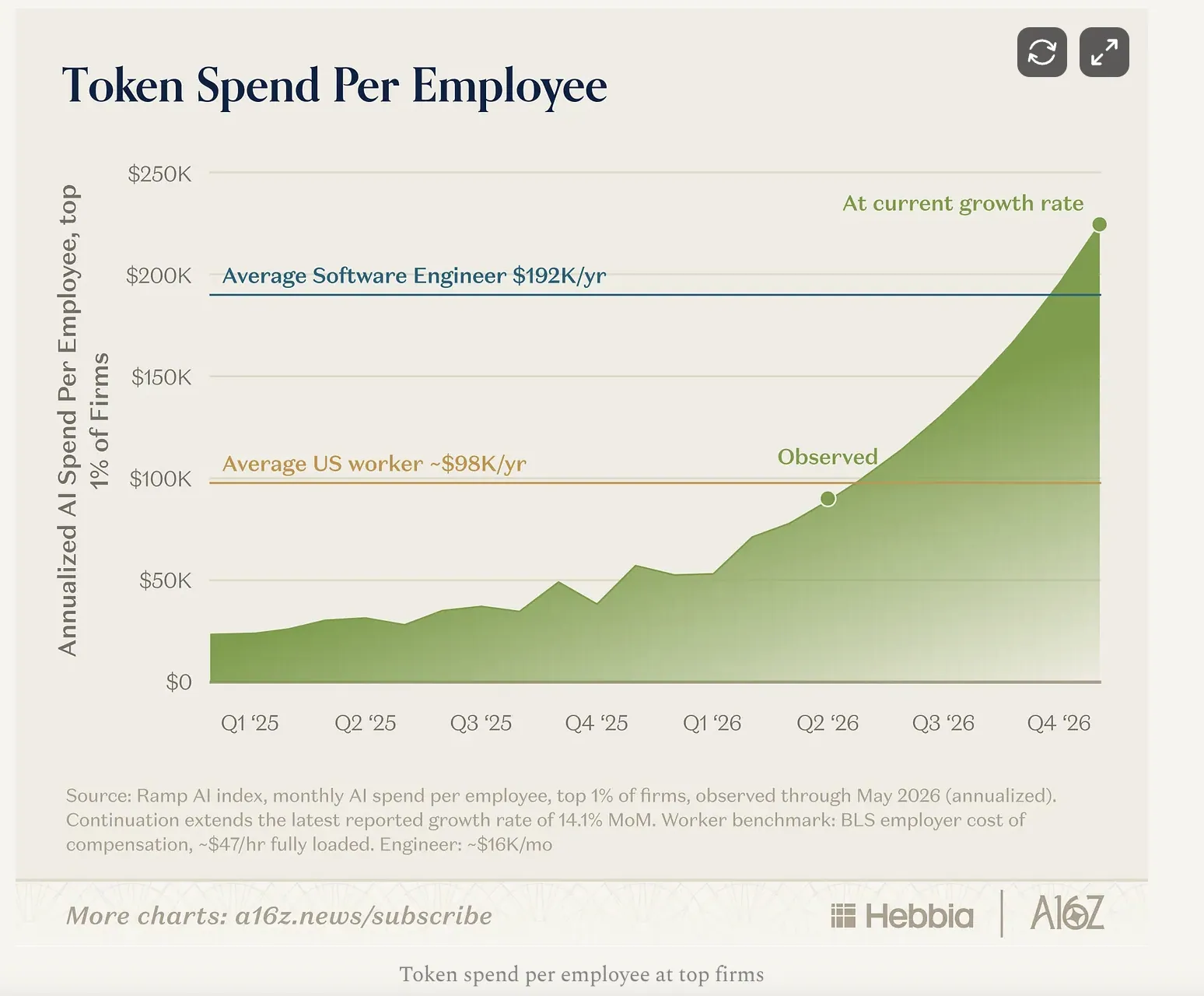
Every company now has a second workforce. One is human, the other is digital. Most boards govern only the first. That single idea changes how I think about AI, because AI does not remove the need for leadership. It changes what leaders have to lead.
Judgment becomes scarce when intelligence becomes abundant
For most of history, leaders created value because information was scarce. The executive who had the best information usually made the best decisions. That world is disappearing. Today information is abundant, knowledge is abundant, and execution is increasingly abundant. Judgment is not.
AI can generate a thousand ideas; leaders decide which ten deserve resources. AI can write hundreds of pages; boards decide which strategy the company should pursue. AI can run hundreds of loops in an hour; someone still has to decide whether those loops should exist in the first place.
Leadership does not disappear. It becomes more valuable, because someone still has to make sense of an increasingly intelligent organisation.
AI doesn't replace managers. It creates new management problems.
Technology has always solved one problem while creating another. The industrial revolution gave us factories, and modern management followed. The internet gave us knowledge work, and companies reinvented how they collaborated. AI is doing the same thing, only this time the management challenge is not people alone. It is people and digital workers.
When one employee creates twenty AI agents, who owns them? When agents start calling other agents, who ensures they are not simply creating more work for each other? When every department optimises locally with AI, who ensures the company does not become globally inefficient?
Without governance, AI does not just scale productivity. It scales complexity. The organisations that struggle with bureaucracy today risk creating digital bureaucracy tomorrow.
The new competitive advantage isn't AI. It's management.
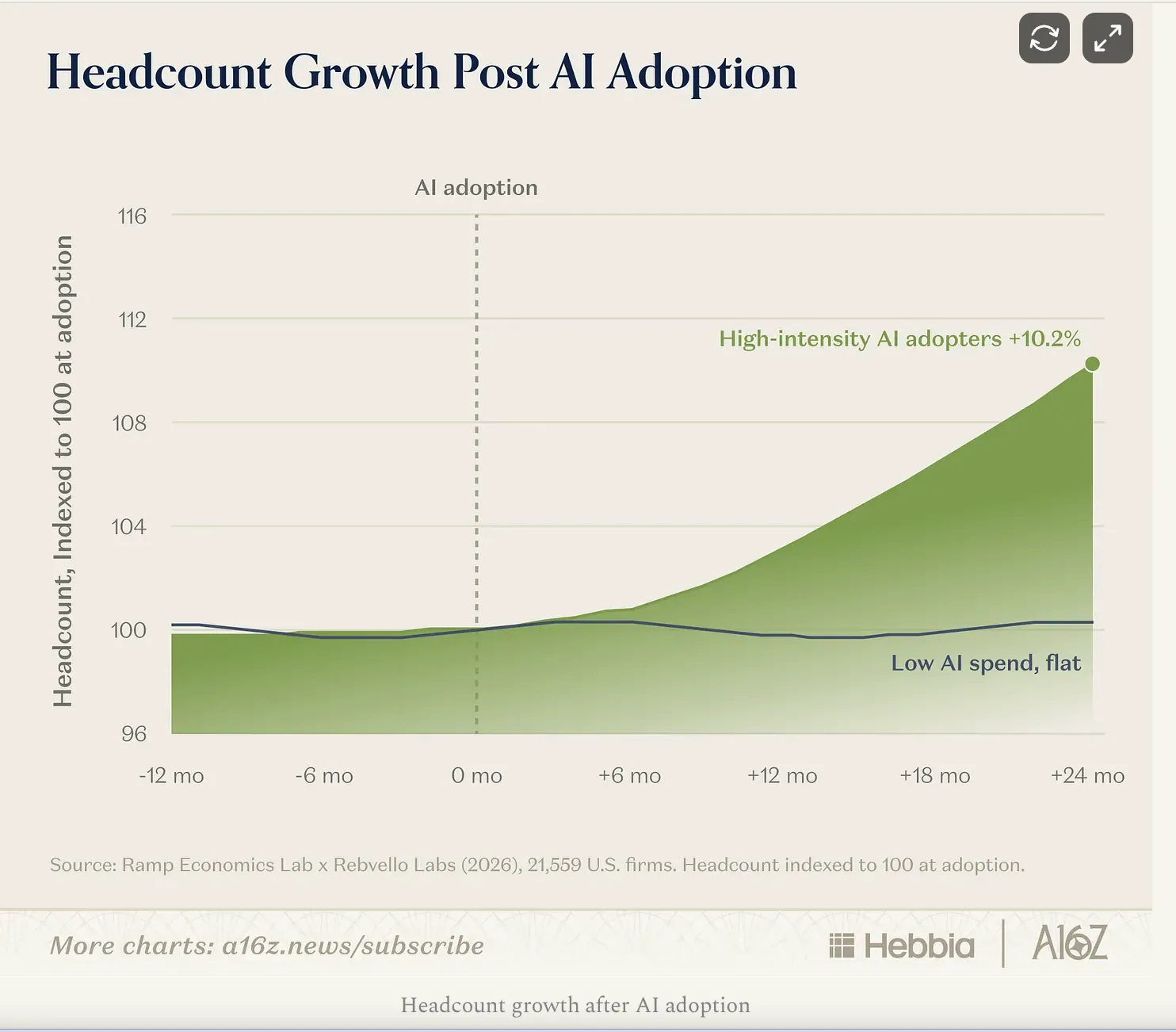
One chart in the research surprised me. The companies adopting AI most aggressively are not cutting headcount. They are growing faster than those that are not. That makes sense. Throughout history, transformative technologies rarely eliminated organisations; they expanded them.
AI will not simply replace employees. It will let every employee become dramatically more productive. But productivity without direction creates noise, not leverage. The winners will not be the companies with the most AI agents. They will be the companies with the fewest unnecessary ones: the companies that know which workflows should be automated, which decisions should remain human, and which knowledge should become institutional rather than staying locked inside individuals.
That is a management capability, not a technology capability.
Why this matters for boards
Boards have always governed financial capital. They oversee human capital. Increasingly, they will need to oversee digital capital, not by debating which model the company should use, but by asking better questions.
- Who owns our digital workforce?
- Which AI agents are making operational decisions today?
- How do we know they are creating value rather than simply generating activity?
- Where are we measuring AI productivity instead of AI usage?
- What governance exists around the hundreds, or soon thousands, of AI systems our people are building?
These are no longer technology questions. They are leadership questions. The next decade will not belong to the companies with the smartest AI. It will belong to the companies that learn how to lead it.
The essay and the two charts above are by George Sivulka and Andreessen Horowitz (a16z), reproduced here with credit. Read the original essay at a16z.news.
The AI edge for boards and portfolios. Your AI analyst for post-investment board work.
BoardLens gives directors a single secure workspace across every board they serve, while keeping each company's information completely separate and confidential. It analyzes board materials over time, tracks commitments and follow-ups, maintains a governance calendar of meetings, covenants, and reporting deadlines, and drafts follow-up emails straight from your minutes or transcripts.
Governance-grade by design: your data is never used to train AI models, enterprise agreements and DPAs are in place with every underlying provider, and all data is encrypted in transit and at rest, in an isolated workspace per company.
Start free, with a demo company already set up so you can explore it without uploading your own materials. www.boardlens.ai
Enjoyed this? Get the next one.
Subscribe to The AI Leadership Edge for new insights as they land.